Troubleshoot OEM warning in Intel Driver & Support Assistant / Intel Graphics
What to do first
Record OEM warning, verify the affected product and environment, correct the confirmed prerequisite, and retry once under the same conditions.
This is a general troubleshooting guide, not an announcement of a current outage.
Affected products and symptoms
- Product
- Intel Driver & Support Assistant / Intel Graphics
- Versions and conditions
- Windows 10 / 11, OEM PC
- Error codes and identifiers
- OEM warning
Symptoms
- The operation fails with OEM warning.
- The same failure is reproducible in Intel Driver & Support Assistant / Intel Graphics.
Causes and conditions
The official article identifies a product, compatibility, storage, update, network, file, or configuration condition that must be resolved before retrying.
Before you start
- Close applications and record the exact PC or GPU model, Windows build, current driver version, and complete error.
- For a laptop or branded PC, check its model support page and obtain a recovery OEM driver before making changes.
Precautions
- Use signed GPU or PC-maker packages, not unofficial drivers, individual DLL downloads, or registry tools.
- Do not open a laptop or bulk-remove a healthy multi-GPU configuration that includes integrated graphics.
Step-by-step instructions
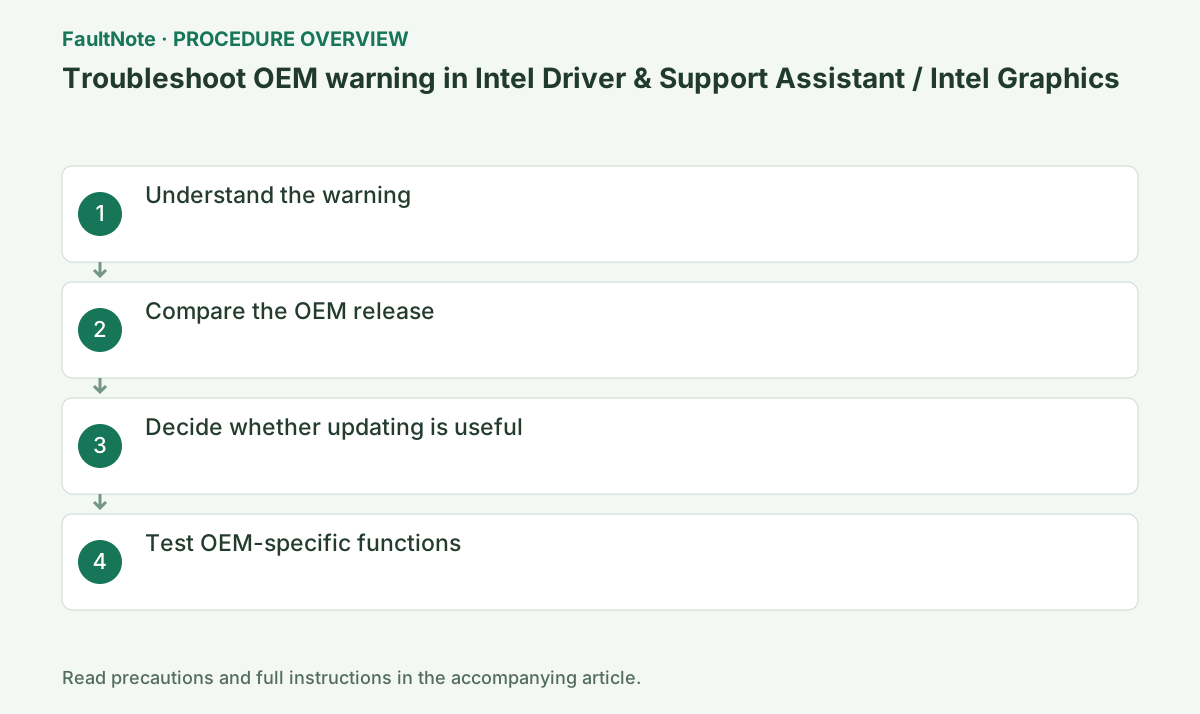
DSA warns that a generic Intel driver may overwrite PC-maker customization. Record PC model, current version, and the symptom you intend to fix.
Review the model-specific driver and notes. Prefer it where brightness keys, docks, switchable graphics, or power tuning are customized.
If the OEM driver is stable and there is no specific fix or security need, you can decline the generic update. Save the OEM package before testing Intel's release.
After restart test internal/external displays, brightness, sleep, and video. Roll back or reinstall the OEM package if anything regresses.
Check the result
- OEM warning no longer appears and the operation completes.
- The selected version and settings remain after restart.
- A second test shows no new display, input, save, or synchronization problem.
If the problem continues
- Restore reversible settings from the notes and escalate without deleting user data.
- Prefer the PC maker or administrator procedure for OEM drivers and managed networks.
- Protect account names, tokens, and save contents before sharing logs.
Scope of this guide
Troubleshooting guide — A general diagnostic guide based on official support. It does not claim a current incident or a version-specific fix.
Frequently asked questions
Is the OEM warning an error?
No. It asks you to accept the risk of replacing customizations; it does not prove the update is required.
Is a higher Intel version always better?
No. An older OEM build may include model-specific validation and changes.
Official sources and dates
Source publication or resolution date: Not specified. Sources checked: 2026-09-05. The check date is not the date the problem first occurred. Interface labels can vary between versions and display languages.
Related troubleshooting guides
- Troubleshoot 173 in AMD Software: Adrenalin Edition
- Troubleshoot 174 in AMD Software: Adrenalin Edition
- Troubleshoot 175 in AMD Software: Adrenalin Edition
- Troubleshoot 176 in AMD Software: Adrenalin Edition
- Troubleshoot 183 in AMD Software: Adrenalin Edition
- Troubleshoot 193 in AMD Software: Adrenalin Edition